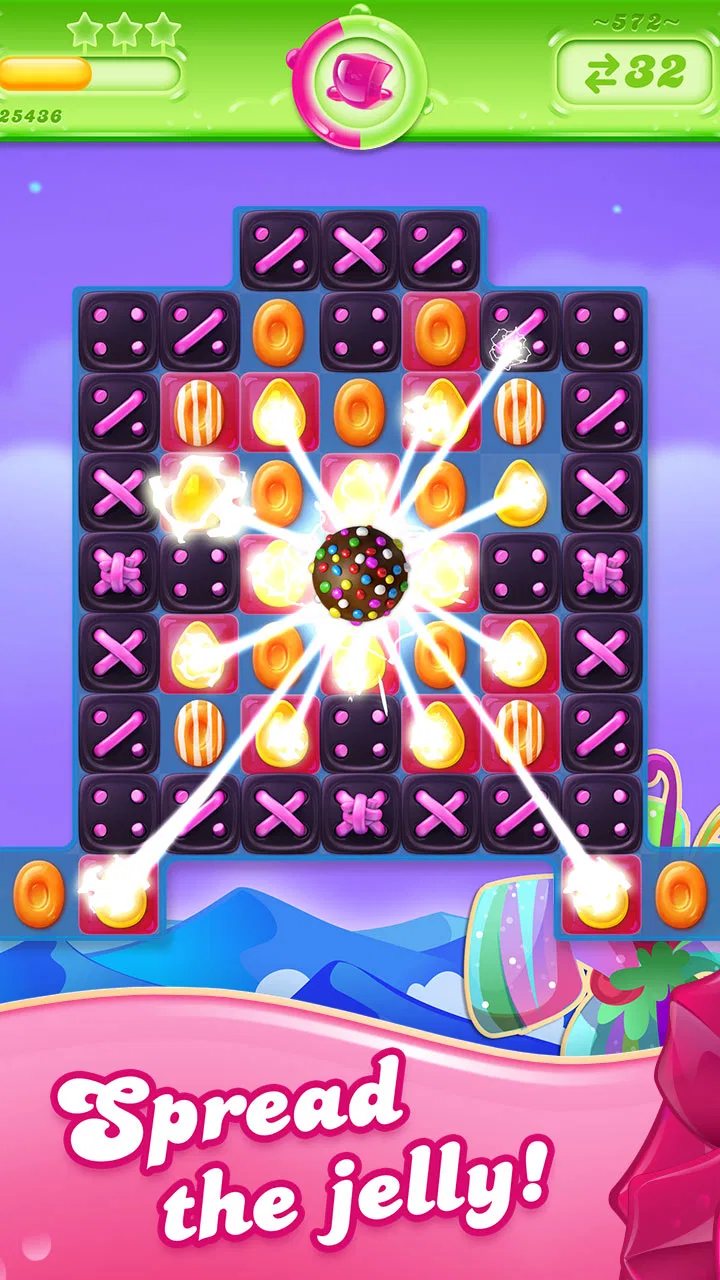
Candy Crush Jelly Saga
- 4.6
- Rating
- 100.00M
- Installs
- Free
- Price

 Analysis by App-foxy
I spent time with Candy Crush Jelly Saga as a pick-up-and-play puzzle game, and its defining strength is easy to understand: each level turns a familiar match-three board into a small tactical problem built around spreading jelly and dealing with the Jelly Queen. That extra objective changes the way I play. I am not simply clearing colorful pieces for a high score; I am deciding where every match should happen so the board becomes useful instead of merely empty.
That distinction is why this game remains more interesting than a basic matching exercise. It is free to start, made by King, and suitable for Everyone, so it is approachable for children, casual players, and adults who want something light during a break. At the same time, later puzzles can demand patience and careful planning. My overall impression is positive, but I would recommend it most strongly to people who enjoy short attempts, gradual progression, and the satisfaction of improving a plan after a failed try.
The jelly objective gives ordinary matching a tactical purpose
The central capability is the way jelly becomes the board’s real territory. A move can look attractive because it removes several pieces, yet still be poor if it leaves the important spaces untouched. I quickly learned to judge a match by what it opens, what it blocks, and whether it helps the jelly reach a more useful area. This makes the game feel less automatic than many casual puzzle titles.
You May Also Like

 Blood Strike: 2.5 Anniversary
Blood Strike’s Loadouts Turn Every Drop Into a Tactical Gamble
A close look at Blood Strike’s custom loadouts: how fast access to signature weapons reshapes its battle royale rhythm, rewards preparation, and narrows the gap between fights.

 Pandora - Music & Podcasts
Pandora’s Music Is Easy to Start, but Harder to Recover
Pandora’s strength is its low-effort path from a seed to a station. Its weak spot is how much confidence it asks you to place in connection, setup, and quiet recovery.

 8 Ball Pool
 Is Built on Rivalries, Rematches, and Routine
A close look at the rivalries, rematches, shared routines, and unanswered safety questions that turn a quick pool match into a persistent mobile community.

 Samsung Music
’s Quiet Strength Is Playing What You Already Own
Its reach comes less from spectacle than from dependable access to a personal library. That simplicity is both the app’s strongest retention engine and its ceiling.

 AccuWeather: Weather Radar
AccuWeather Review: A Quick, Clear Forecast for Everyday Decisions
For everyday plans, the best forecast is the one you can understand quickly. AccuWeather makes rain timing, radar, and local conditions easy to act on, with a few trade-offs.

 Hill Climb Racing
Why Hill Climb Racing Still Turns Crashes Into One More Run
A tiny car, a bumpy hill and one more upgrade: Hill Climb Racing keeps resurfacing because its simple chaos makes every near-miss feel personal.
More From Our News Desk
View All News


The Jelly Queen also gives the experience a character that a standard match-three layout lacks. Her presence frames the levels as a playful contest rather than a disconnected series of boards. I found that this made a difficult stage easier to return to, because failure felt like a problem to solve rather than a reason to abandon the game.
There is a useful tension between immediate rewards and long-term positioning. A large combination can clear space and create opportunities, but a smaller match may be better if it expands the jelly into a corner or exposes pieces needed for the next move. The strongest habit is to think about territory before chasing spectacle. That single change in attention improves the way the game feels.
Why the capability matters more than the familiar format
Match-three games often rely on quick recognition: find three matching pieces, tap, and repeat. Here, I still get that comfortable rhythm, but the jelly objective asks me to look beyond the current turn. A move has a local effect on the pieces immediately involved and a wider effect on the shape of the board. That second effect is where most of the meaningful decisions come from.
This is especially noticeable when several possible matches are available. I may have one move that produces a larger instant clear and another that reaches a less obvious section of the board. The first feels satisfying, while the second is often the better strategic choice. The game teaches this difference naturally, without requiring a long tutorial or complicated controls.
Compared with a purely score-focused puzzle, the result feels more goal-oriented. Compared with a calm tile-matching game, it has more pressure because the board can become awkward if I spend moves carelessly. Players who enjoy planning several turns ahead will probably appreciate this layer. Players who want every move to be relaxing and consequence-free may find it more demanding than expected.
How the jelly mechanic works during an ordinary session
In practice, I usually begin by scanning the entire board instead of making the first obvious match. I look for combinations that can spread jelly, remove awkward pieces, or create a route toward areas that are difficult to reach. This takes only a few seconds, but it prevents the common mistake of using a useful opening move simply because it is visible.
Once the first match is made, the board changes quickly. New pieces fall into place, and the next decision may be different from the one I expected. I try to preserve flexibility when possible. A move that leaves several matching possibilities is often more valuable than one that clears a single cluster and leaves the remaining board fragmented.
My most useful adjustment was to stop treating special combinations as automatic wins. They can be powerful, but using one immediately is not always wise. Sometimes I hold back a promising arrangement until it can affect a larger section of the board. This is a small but important trade-off: immediate clearing feels safe, while delayed use can produce a much stronger result if the board cooperates.
A practical approach for difficult boards
When a level starts to feel stuck, I use a simple three-step routine. First, I identify the area where jelly needs to spread rather than focusing on the easiest match. Second, I check whether a move will create access to that area or merely remove pieces elsewhere. Third, I consider whether the resulting drop could create a better combination on the next turn.
This routine is more reliable than repeatedly making random matches. It also helps me recognize when a board has become unfavorable. If every available move closes off the useful route, restarting the attempt can be more sensible than spending the remaining turns hoping for a lucky fall. That is one of the game’s less obvious lessons: good play includes knowing when the current arrangement has lost its potential.
I also pay attention to the edges and corners. They are easy to ignore because the center usually offers more visible combinations, but awkward spaces can determine whether the jelly objective is completed. A move that seems modest in the center may be valuable if it opens a path toward an isolated section. This makes board awareness more important than fast tapping.
What the progression feels like on a phone
The game works well in short sessions because a single attempt is easy to understand from the first glance. I can play while waiting for transport, during a coffee break, or at home when I want something more active than scrolling. The controls are simple enough that I do not need to relearn them after putting the game down for a while.
Its current version is 4.12.1.0 and it requires Android 6.0 or later. That makes it accessible on a broad range of Android devices, although the experience will still depend on the phone’s screen, responsiveness, and available space. I would leave room for the game’s visual presentation and interactive elements rather than treating it like a tiny utility that should be opened and closed instantly.
The game has been available since January 6, 2016, and its long presence is reflected in how polished the basic loop feels. It does not take much effort to understand what a level wants from me. The challenge comes from making better choices, not from deciphering an unfamiliar interface.
The best everyday scenario is a short session with a clear stopping point
My favorite use is a ten-minute break when I want a game with enough thought to hold my attention but not enough complexity to require preparation. I can open a level, inspect the board, try a few approaches, and stop after a win or a failed attempt. That clear structure suits moments when I do not want an open-ended game demanding a long commitment.
For example, if I am waiting for an appointment, I can play one attempt without needing to remember a complicated story or manage a large collection. The jelly objective gives the session a concrete purpose, so the time feels more satisfying than simply matching pieces until I lose interest. If I fail, I usually understand what went wrong: I spent moves in the wrong area, missed a better combination, or allowed the board to become too restricted.
It can also work as a shared casual game for families because the basic controls are easy to explain. A younger player can enjoy the colors and immediate matches, while an older player can discuss why a particular move is better. The Everyone rating supports that accessible tone, though the increasing difficulty means not every level will feel equally comfortable for every age or patience level.
I would not choose it for a long train journey if I wanted a completely uninterrupted experience without any temptation to continue after a loss. Its short-session design is a strength, but the repeated “one more try” rhythm can make a brief break longer than planned. That is not a flaw unique to this game, yet it is worth recognizing before starting when I have somewhere else to be.
How it compares with familiar puzzle alternatives
Against a basic match-three game, this one offers a clearer reason behind each move. The jelly territory gives me an objective beyond producing attractive combinations, so I spend more time planning. If I prefer simple relaxation and do not want to think about board position, a less goal-driven matching game may be a better fit.
Against tile-merging puzzles, the experience is faster and more reactive. I do not spend the same amount of time building a long-term numerical structure; instead, I respond to falling pieces and changing opportunities. Someone who enjoys carefully managing a persistent board may prefer a merging game, while someone who likes immediate visual feedback will likely feel more at home here.
It also differs from word puzzles because the challenge is spatial rather than language-based. There is no need to search for vocabulary or maintain a large knowledge base. That makes it a good choice when I want a puzzle that depends on observation and timing, although it offers less variety for players who need constant changes in rules or subject matter.
The trade-offs become clearer when progression gets tougher
The biggest limitation is that the same concise loop that makes the game accessible can become repetitive. The board changes, the objectives create different pressures, and the Jelly Queen adds personality, but the fundamental action remains matching pieces. If I play for a long stretch, I can feel the pattern settling into repetition.
Difficulty is another important consideration. Early levels are inviting, but later puzzles ask for more deliberate choices and sometimes a favorable sequence of pieces. I enjoy that challenge when I have the patience to retry, yet it can feel frustrating when a carefully planned attempt is undermined by an unhelpful board. Players who dislike repeating a level should approach it as a game of experimentation rather than expecting steady progress every time.
The game is free to download and play, but it includes in-app purchases ranging from $0.99 to $99.99 per item. I recommend deciding in advance whether I am comfortable with optional spending, especially because a difficult level can make a paid shortcut feel tempting. The free entry point is useful, but the purchase range means the experience is not identical to a one-time paid puzzle with every element settled upfront.
For me, the best way to keep the game enjoyable is to treat failed attempts as information and avoid turning every obstacle into a reason to buy something. I look for a different opening, protect useful spaces, and try again later if I am making rushed decisions. That approach preserves the strategic part of the game and reduces the pressure to solve everything immediately.
When another kind of game would be better
I would skip this title if I wanted a story-heavy adventure, a competitive multiplayer experience, or a puzzle game with a completely new rule set on every stage. Its appeal is focused: colorful matching, jelly expansion, and progressively more demanding board decisions. That focus is approachable, but it also means the game will not satisfy someone looking for deep narrative or broad mechanical variety.
I would also choose a different option for a child who becomes upset by repeated failure or asks to keep playing after every loss. The Everyone rating makes the content broadly accessible, but age suitability and emotional suitability are not exactly the same thing. A calmer, more predictable puzzle may be preferable for a player who needs constant success.
Likewise, people who want a fully offline-style pastime with no purchase pressure may prefer a traditional paid puzzle. This game’s free model makes it easy to try, but the optional purchase structure is part of the experience and should be considered before recommending it to someone who strongly prefers a fixed-cost app.
Who gets the most from Candy Crush Jelly Saga
The best audience is someone who enjoys compact strategic decisions and does not mind retrying a board. I think it suits casual players who want more substance than tapping the first available match, as well as experienced puzzle fans who like finding efficient routes through a restricted layout.
It is especially good for players who can enjoy gradual improvement. The satisfying moment is not only winning; it is noticing that I now read the board differently. I spot edge problems earlier, save stronger combinations for a better moment, and stop wasting turns on matches that do not advance the real objective. Those are small improvements, but they make repeated sessions feel purposeful.
The large audience is understandable: the game has passed over 100 million installs, with an average rating of 4.6 from around 1.8 million ratings and roughly 97 thousand reviews. Those figures suggest broad appeal, but they do not remove the personal trade-offs. A popular puzzle can still be wrong for someone who dislikes retries, in-app purchases, or a familiar format.
For a friend who wants a free puzzle to play in short bursts, I would recommend giving it a try. I would explain that the key is not simply making the biggest match, but spreading jelly intelligently and keeping future options open. I would also mention the purchase range before handing it to a younger player or someone who wants a strictly no-spend experience.
After playing it with that mindset, I see it as a dependable match-three game with one meaningful strategic hook rather than an endlessly varied puzzle collection. The jelly objective gives ordinary moves a larger purpose, and the Jelly Queen keeps the presentation lively without making the controls complicated. If you enjoy planning around space, accepting occasional failure, and playing in short focused sessions, this is an easy recommendation. If you want a one-time purchase, deep narrative, or a radically different puzzle system, I would point you elsewhere.
FAQs for Candy Crush Jelly Saga
01What is Candy Crush Jelly Saga about?
Candy Crush Jelly Saga is a match-three puzzle game developed by King. Players need to match three or more jelly candies of the same color to spread jelly across the board, complete objectives, and face off against the game’s boss, Jelly Queen. It’s a fun twist on the classic Candy Crush gameplay with new challenges.
02Is Candy Crush Jelly Saga free to play?
Yes, Candy Crush Jelly Saga is free to download and play on both Android and iOS devices. However, it offers in-app purchases for extra moves, lives, and other items. While these purchases can enhance gameplay, they are optional, and players can advance through the game without spending money.
03How do I sync my game progress across different devices?
To sync your progress, connect Candy Crush Jelly Saga to your Facebook account or a King account. This allows you to save your game progress and access it from any device by logging into your account. Make sure you have a stable internet connection to ensure your progress is updated.
04What are some tips to get past difficult levels?
Focus on spreading jelly efficiently by making large matches and creating special candies. Use boosters strategically to clear challenging areas. If you're stuck, take a break and return with a fresh perspective. Check online forums and guides for specific level strategies if needed.
05Are there any events or special challenges in the game?
Yes, Candy Crush Jelly Saga frequently hosts events and special challenges that offer unique rewards and new gameplay elements. Participating in these can earn you boosters and other helpful items. Keep an eye on the game’s notifications for upcoming events to maximize your rewards.
Pros
- Addictive gameplay with vibrant visuals.
- Frequent updates with new levels.
- Variety of challenging game modes.
- Smooth animation and sound effects.
- Free to play with optional purchases.
Cons
- In-app purchases can get expensive.
- Requires constant internet connection.
- Limited lives can halt progress.
- Advertisements can be intrusive.
- Occasional game crashes reported.

Candy Crush Jelly Saga
Gallery